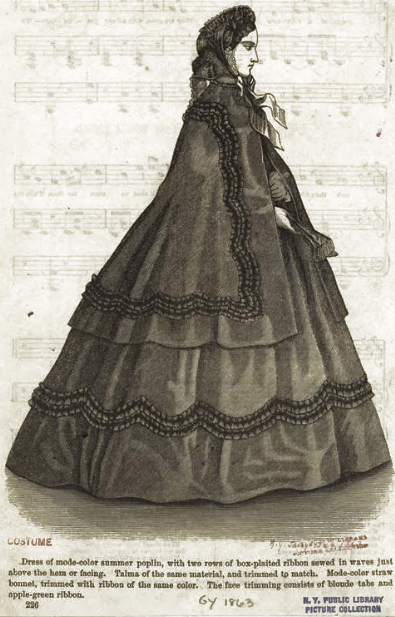
One of Baltimore’s most intriguing “Queer Characters” was the so-called “Lady in Black,” who was arrested multiple times in the city during the summer of 1862. Taking the attire of a war widow—along with an elegant parasol and fan—she was repeatedly arrested for ‘charming’ soldiers and young men near Union Army camps. Identified alternately as Charlotte, Caroline, or Charley Waters (with surnames like Walker or Wilson also in play) and originally from Albany, New York, her story saw her detained numerous times in multiple cities.
That June, Waters found herself in trouble after seducing a “bold soldier boy from New York.” Unfortunately for her, the soldier later bragged about his conquest to his commanding officer–who it turns out was a former high-ranking NYPD official, and who recognized Waters from a prior arrest in New York City for being “a man in women’s clothing.” Arrested again, she promised to leave town—only to be caught days later checking into another hotel with a different man. Despite repeated arrests, she charmed her way out each time, eventually leaving Baltimore and crossing the Civil War’s front lines, winding up in Augusta, Georgia, where similar antics led to another arrest later that year.
This wasn’t Waters’ first brush with the law. In 1856, something curious happened when she attempted to check into a Baltimore hotel while wearing a suit. After hotel staff grew suspicious of her effeminate looks and voice, and cleaning staff spotted women’s clothing in her luggage, the manager called for the police with a startling claim: he believed that a woman had checked into the hotel wearing men’s clothes.
When confronted, rather than correct her accusers, Waters leaned into the drama, spinning a romantic tale of disguising herself as a man to search for a forbidden suitor who her overbearing father didn’t approve of. The story worked: police released her with a new dress and sent her back to Albany. But this was just the beginning of a year-long journey through cities like Rochester, New York City, and Washington, D.C., where she was repeatedly arrested—sometimes as a “woman in men’s clothing” and other times as a “man in women’s clothing.”
Waters’ ability to navigate these arrests often relied on her polished appearance and charm, which drew leniency from officials. Her delicate features, soft voice, and long, fine, auburn hair done in the latest styles fascinated reporters and the public alike. Being seen as a “woman in men’s clothing” often led to less severe penalties than the reverse, and at times, she cleverly used that double standard to her advantage, presenting herself in ways that minimized consequences.
Yet Waters’ privilege as a white, seemingly middle-class individual played a critical role in her ability to avoid harsher treatment. Her charms got her out of trouble, but they required authorities to see her as respectable enough to gain their sympathy. Her story and the way authorities responded to her reveal how these privileges of race and class interacted with the mid-19th century’s evolving discomfort with gender nonconformity.

 a gay little history page