a gay little history of maryland: volume one

Where to Buy:
Buy online from Red Emma’s: Click here
Map of retailers: Click here
Wholesale (for bookstores/retail): Click here
About the book:
a gay little history of Maryland, volume one is the first collection of work from librarian and researcher Ben Egerman, whose writings and presentations on the state’s LGBTQ+ past have entranced crowds in Baltimore and beyond since 2018. From trans horse thieves in 19th century Baltimore to Southern Maryland’s 1960s secret gay getaway, these lovingly researched stories span 150 years and take place all across the state. The first book ever published on Maryland’s LGBTQ+ history, a gay little history of Maryland, volume one proves that our state’s story is far less straight and narrow than you think!

Author Statement:
I started this project to try and take some of the research I’ve done for almost a decade and provide it to as broad an audience as I can. My feeling is that this is community history: it belongs to the community. So I try to present it in ways that are accessible and fun without losing the detail and nuance of these stories.
I wrote these pieces to show that queer and trans people have always been a part of Maryland’s story. But that’s not the only lesson:
I also wanted to point out that Maryland has a long tradition of Black LGBTQ+ cultural and political leadership that has shaped our communities–ranging from drag pageants of Jazz age West Baltimore to early leaders of the LGBTQ+ rights movement in the state like Paulette Young, A. Billy Jones, Louis Hughes, and many more.
And I very much wanted to point out that Maryland’s LGBTQ+ stories are not limited to the Baltimore and DC metro areas, but span the entire state. From 1960s gay beach towns in rural Southern Maryland to an explosive 19th-century lesbian murder trial on the Eastern Shore, our queer past is not confined to big cities.
Finally, I wanted to make something that could be used to bring people together and build community around our shared history. Something that would help people learn about themselves, their history, and the place they call home.
Photos and Files:


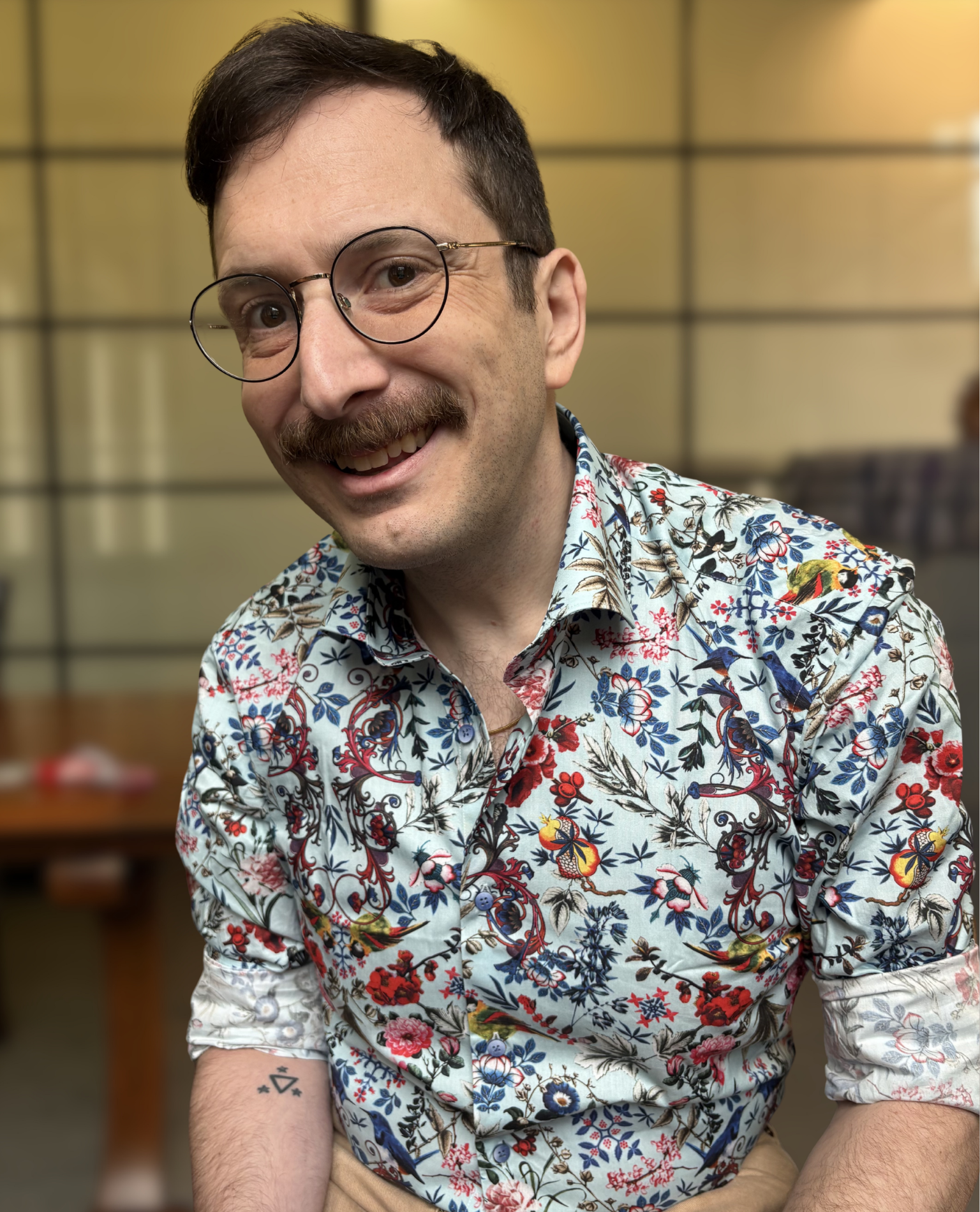


Bios:
Short Bio:
Ben Egerman is a public librarian, historian, and homosexual who has focused on local LGBTQ+ history research and education since 2018. Starting in 2025, Ben began turning his research into bite-sized, self-published zines, sold at local bookstores and at his popular “gay little history nights” at The Club Car, a queer bar and art gallery in Baltimore. In June 2026, working with Red Emma’s Bookstore, the first six of these zines were compiled together and published as volume one of a gay little history of Maryland.
Long Bio:
Ben Egerman is a public librarian, historian, and homosexual who has focused on local LGBTQ+ history research and education since 2018. He is a co-author of the Maryland LGBTQ+ Historic Context Study, which received the LGBTQ+ Historical Association’s 2024 Alan Bérubé Prize for community history. He has spoken about local LGBTQ+ history nearly 100 times, crisscrossing the state to speak in libraries, universities, bars, museums, and more.
In 2025, Ben began turning his research into bite-sized, self-published zines, selling hundreds to standing-room-only crowds at his “gay little history nights” at The Club Car, a queer bar and art gallery in Baltimore. In June 2026, working with Red Emma’s Bookstore, the first six of these zines were compiled together and published as volume one of a gay little history of Maryland.
Ben lives in Baltimore with his husband and a cat who, like Ben, is fairly annoying but gets away with it cuz he’s so darn cute.
Press:
“Librarian and researcher Ben Egerman’s “Gay Little History” zines have gained a cult following among those curious about the queer history of Maryland.”
Baltimore Beat, “What’s Poppin’ Issue #084,” June 16, 2026
“More than 100 people crowded into The Club Car in Station North on a recent Thursday evening, not for a drag show or dance party, but for an event many found equally exhilarating — a history lesson.
As the crowd cheered and whistled, host Ben Egerman recounted some of the topics he had discussed in previous talks: an 1830s trans horse thief, the Black Baltimore drag queens of the 1920s “Pansy Craze” and a 1955 police raid on a Baltimore gay bar, The Pepper Hill Club.”
Baltimore Banner, “Bringing Maryland’s LGBTQ+ history out of the closet,” March 12, 2026
“…a lesbian couple living in Brunswick attended the event to learn more about history and feel more welcome in the area. The two moved from Richmond, Virginia, in 2022.
“We moved here from a more progressive city, so we feel a bit like more of a minority, but at the same time, seeing programs like this helps us feel really welcome here,” [one] said. “It’s just nice to see stuff like this. It makes us feel more welcome and comfortable existing in this area”
Frederick News-Post, “Librarian explores rural Maryland’s enduring LGBTQ+ history,” June 28, 2025

Excerpt from zine three: The Pocomoke Tragedy
…The shooting happened in Worcester County on Maryland’s Eastern Shore. These days, the area is mostly known for Ocean City, with its beaches and boardwalks, where college kids go to get blackout drunk and seagulls go to live like kings on discarded french fries. But this was before any of that–before Ocean City was much of anything. In the 1870s, Worcester County was entirely rural, dotted with small towns like Pocomoke City.
There lived 20-year old Lillian Duer and her “intimate friend,” 18-year-old Ella Hearn. Both were well-liked, young, middle-class white women, and they were well known to be extremely close. Ever since the Hearns had moved to town four years prior, the two had been seen together nearly every day, walking arm-in-arm or hand-in-hand. And it was there that on November 5, 1878, in the entryway to the Hearn family home, Lillian raised her pistol, aimed at Ella, and shot.
The bullet lodged in Ella’s upper jaw. The Hearns’ family doctor arrived, but could not remove the bullet because it caused Ella immense pain and the doctor was concerned over sedating a frail young girl with a delicate constitution. (Ella was 18, described as “slightly stout,” and in good health. Well, other than having just been shot). Instead, he cleaned the wound and stitched it up without removing the bullet.
Papers treated it as a tragic accident, making sure to give all the gory details. Articles described the bloody aftermath, underlining what the writers all saw as a fatal mistake: letting women have guns. Newspapers poked fun at how, in what they thought of as the rural South, people loved their guns so much that they even let young girls (Lillian was 20) carry pistols.
Ella Hearn survived for a surprising 31 days following the shooting. At first, she seemed to be recovering, but after about a week, her condition began to deteriorate. She wavered between being awake and lucid, while other times wild and delirious. She frequently complained of the pain in her jaw–the bullet was never removed–and to help, the doctor had prescribed chloral hydrate, a painkiller and sedative. This helped alleviate the pain, but her condition continued to decline.
As Ella’s condition deteriorated, her father, Jason Hearn, made a shocking disclosure: Ella had told him that Lillian had shot her intentionally, jealous that she was getting close to another young woman named Ella Foster. What he didn’t mention was that his daughter had handed her family a stack of Lillian’s love letters proposing marriage, which were so scandalous she begged them to burn the messages after reading (which they did, much to the chagrin of both prosecutors and future queer historians).
After Ella passed on December 6, Jason Hearn asked town officials to convene a ‘coroner’s jury,’ an assembly of doctors who would determine whether Lillian could be held liable for Ella’s death. They convened and held that Ella was killed by “nervous depression” caused by the shooting (more on that later). Lillian was put under $2500 bail and the case went to the Worcester County courthouse in Snow Hill to be heard by the grand jury the following May.
In Baltimore, a newspaper had caught notice of all this and sent a journalist to town, and on December 12, 1878, the Baltimore Evening Bulletin ran the story alongside interviews with Jason Hearn and Lillian. The next day, it was published in four major New York papers. Within a week, it was covered by most major newspapers in the country…